


IBTROZI: start strong for durable results in TKI-naïve patients1-3
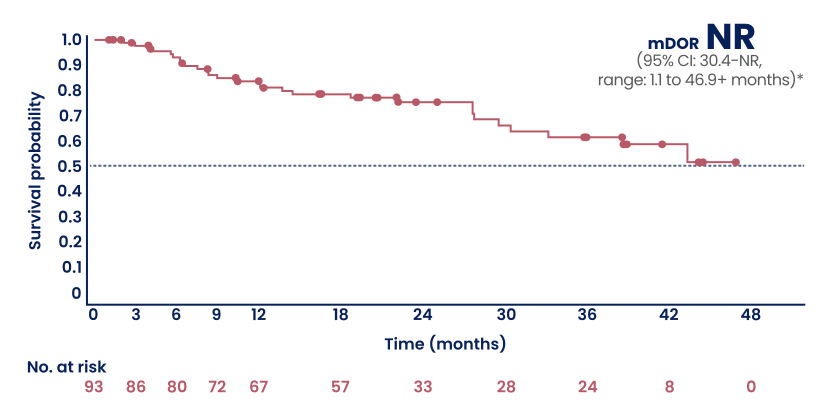
TRUST-I (n=103)
90% ORR
(95% CI: 83–95) 85% PR, 5% CR1
Median follow-up time for response: 40 months (range: 19.9 to 48.7 months)2
mDOR NR
(95% CI: 30.4–NR;
range: 1.1 to 46.9+ months)1
TRUST-I and TRUST-II are ongoing. DOR results for TRUST-II are subject to change as the data mature.
- 72% of responders had an observed DOR of ≥12 months1
- In responding patients, the longest DOR observed was 46.9 months, with response ongoing (range: 1.1 to 46.9+ months)1
Durable response with long-term follow-up2,3
~50 months mDOR
(median=49.7 months [95% CI: 41.3-NR]; range: 1.1 to 57.9+ months)2,3
- Median follow-up time for response: 50 months (range: 30.0 to 58.7 months)2
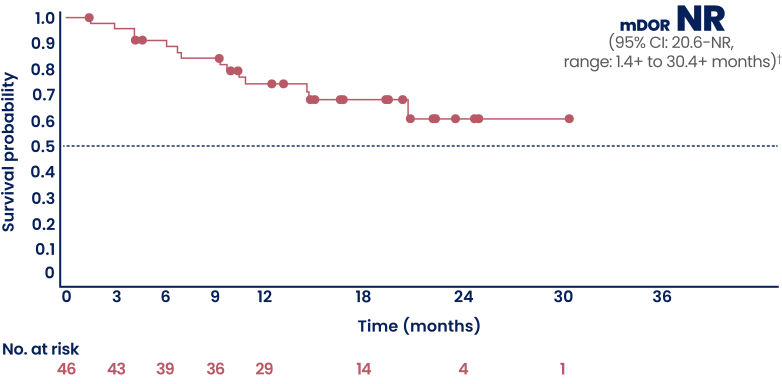
TRUST-II (n=54)
85% ORR
(95% CI: 73–93) 78% PR, 7% CR1
Median follow-up time for response: 19 months (range: 10.6 to 33.1 months)2
mDOR NR
(95% CI: 20.6–NR;
range: 1.4+ to 30.4+ months)1,2
TRUST-I and TRUST-II are ongoing. DOR results for TRUST-II are subject to change as the data mature. mDOR for TRUST-II is not reported in the PI due to shorter duration of follow-up.
- 63% of responders had an observed DOR of ≥12 months1
- In responding patients, the longest DOR observed was 30.4 months, with response ongoing (range: 1.4+ to 30.4+ months)1
All data are from primary analysis (October 2024 cutoff) unless otherwise stated.
*Long-term data are from August 2025 cutoff.
“+” indicates an ongoing response.
For TKI-naïve patients
with locally advanced or metastatic ROS1+ NSCLC,
IBTROZI: a next-generation answer for a first-line question1
TRUST-I AND TRUST-II
Clinically meaningful CNS response in TKI-naïve patients1

73% (n=11/15)
of patients with CNS metastases saw an intracranial response1
TRUST-I and TRUST-II study information
The efficacy of IBTROZI was evaluated in 270 TKI-naïve or TKI-pretreated patients with ROS1+ NSCLC who received IBTROZI 600 mg once daily, enrolled in 2 multicenter, single-arm, open-label clinical trials. Patients were required to have histologically confirmed, locally advanced or metastatic, ROS1+ NSCLC with an ECOG PS ≤1, and measurable disease per RECIST v1.1. The primary and key secondary endpoints were confirmed ORR and DOR according to RECIST v1.1, as assessed by BICR. All patients were either chemotherapy naïve or had received prior chemotherapy for locally advanced disease. Patients received IBTROZI until disease progression or unacceptable toxicity.1
SELECT SAFETY INFORMATION
Hepatotoxicity: Hepatotoxicity, including drug-induced liver injury and fatal adverse reactions, can occur. 88% of patients experienced increased AST, including 10% Grade 3/4. 85% of patients experienced increased ALT, including 13% Grade 3/4. Fatal liver events occurred in 0.6% of patients.
Increased AST or ALT each led to dose interruption in 7% of patients and dose reduction in 5% and 9% of patients, respectively. Permanent discontinuation was caused by increased AST, ALT, or bilirubin each in 0.3% and by hepatotoxicity in 0.6% of patients.
Monitor liver function tests prior to treatment, every 2 weeks during the first 2 months, then monthly thereafter as clinically indicated. Test more frequently if transaminase elevations occur. Based on severity and resolution, withhold, then resume at a reduced dose or permanently discontinue.
Robust responses demonstrated in patients who received prior TKI treatment1,2
TRUST-I AND TRUST-II
TRUST-I (n=66)
Median follow-up time for response:
33 months (range: 20.2 to 46.0 months)2
52% ORR
(95% CI: 39–64)
52% PR, 0% CR1
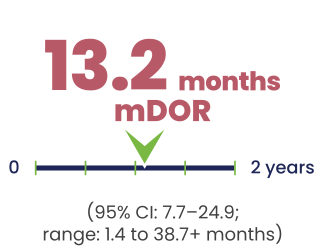
(95% CI: 7.7–24.9; range:
1.4 to 38.7+ months)1
- 74% of responders had an observed DOR of ≥6 months1
- 44% of responders had an observed DOR of ≥12 months1
TRUST-II (n=47)
Median follow-up time for response:
19 months (range: 8.0 to 32.2 months)2
62% ORR
(95% CI: 46–75)
51% PR, 11% CR1
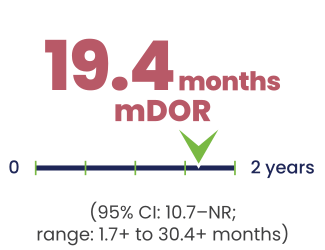
(95% CI: 10.7–NR; range:
1.7+ to 30.4+ months)1,2
- 83% of responders had an observed DOR of ≥6 months1
- 45% of responders had an observed DOR of ≥12 months1
TRUST-I and TRUST-II are ongoing. DOR results for TRUST-II are subject to change as the data mature. mDOR for TRUST-II is not reported in the PI due to shorter duration of follow-up.
All data are from primary analysis (October 2024 cutoff) unless otherwise stated.
*Long-term data are from August 2025 cutoff.
“+” indicates an ongoing response.
CNS activity and response in those with resistance mutations observed in previously treated patients1,2,4
TRUST-I AND TRUST-II
63% (n=15/24)
of patients with CNS metastases saw an intracranial response1

53% (n=8/15)
of patients with acquired resistance mutations saw a response1
- Responses observed in 62% (8/13) of patients with G2032R resistance mutations2
- Solvent front mutation G2032R is the most common on-target resistance mutation in crizotinib-treated patients1,4
- Responses observed in 62% (8/13) of patients with G2032R resistance mutations2
- Solvent front mutation G2032R is the most common on-target resistance mutation in crizotinib-treated patients1,4
SELECT SAFETY INFORMATION
Interstitial Lung Disease (ILD)/Pneumonitis: Severe, life-threatening, or fatal ILD or pneumonitis, can occur. ILD/pneumonitis occurred in 2.3% of patients, including 1.1% Grade 3/4. One fatal ILD case occurred at the 400 mg daily dose.
ILD/pneumonitis led to dose interruption in 1.1% of patients, dose reduction in 0.6% of patients, and permanent discontinuation in 0.6% of patients. Monitor patients for new or worsening pulmonary symptoms. If ILD/pneumonitis is suspected, immediately withhold; based on severity and resolution, resume at same or reduced dose, or permanently discontinue.
IBTROZI: evaluated in a large population across 2 pivotal trials1,4
More than 300 patients were enrolled in 2 multicenter, single-arm, open-label phase 2 pivotal studies (TRUST-I and TRUST-II) to evaluate the safety and efficacy of IBTROZI, a selective, brain-penetrant TKI. The results were generated in TKI-naïve and TKI-pretreated patients with ROS1+ NSCLC.1,4
PIVOTAL PHASE 2 TRUST TRIALS1,4-6
Key eligibility criteria in TRUST-I and TRUST-II
Inclusion
- Locally advanced or metastatic NSCLC with confirmed ROS1 fusion
- ≥1 measurable lesion per RECIST v1.1
- ECOG PS 0-1
- Stable CNS involvement was allowed
- ROS1 TKI treatment naïve or received 1 prior ROS1 TKI
Exclusion
- Active infection (including active hepatitis B or C)
- Antitumor drugs ≤14 days
- Radiotherapy ≤14 days
- Major surgery ≤4 weeks
- History of ILD or drug-induced pneumonitis
TRUST-I (N=169)
(taletrectinib 600 mg once daily)
TRUST-II (N=101)
(taletrectinib 600 mg once daily)
Endpoints in TRUST-I and TRUST-II
Primary endpoint
- BICR-assessed confirmed ORR per RECIST v1.1
Secondary endpoints
- DOR, IC-ORR per modified RECIST v1.1, PFS, safety
- The efficacy-evaluable population (N=270) included patients with ROS1+ NSCLC with ≥1 measurable lesion at baseline per RECIST v1.1 by BICR and who received ≥1 dose of taletrectinib
- The TRUST-I/TRUST-II safety population (N=337) included patients who were exposed to IBTROZI as a single agent dosed at 600 mg orally once daily until disease progression or unacceptable toxicity
- A pooled safety population (N=352), described in the Warnings and Precautions section of the Prescribing Information, included 337 patients with ROS1+ NSCLC and 15 patients with solid tumors who received IBTROZI 600 mg once daily